Flat Roofing in Tucson, AZ: What Property Owners Need to Know

Flat and low-slope roofing is more common in Tucson than in most U.S. cities. Southern Arizona’s dry climate, Southwestern architectural traditions, and the prevalence of both residential additions and commercial properties have made flat roofing a standard part of the Tucson building landscape. But flat roofs in this market have specific demands — and specific failure modes — that differ significantly from what flat roof guides written for other climates describe.
This guide covers what Tucson property owners need to know about flat roofing systems — including the types that perform best here, the challenges Tucson’s climate creates, what maintenance actually looks like, and how to find a contractor who understands this market.
Why Flat Roofing Is So Common in Tucson
Tucson’s flat and low-slope roofing market is driven by several factors specific to Southern Arizona:
- Architectural tradition: Tucson’s dominant building styles — Spanish Colonial, Territorial, Pueblo Revival, and contemporary Southwestern — frequently incorporate flat or low-slope roof sections as a defining design element. Many of Tucson’s most distinctive homes and commercial buildings were designed with flat roofs as an intentional aesthetic choice.
- Residential additions and casitas: Flat roofing is the standard choice for home additions, guest quarters, covered patios, and garage conversions throughout the Tucson area — where the low profile integrates cleanly with the primary structure.
- Commercial and industrial properties: The majority of Tucson’s commercial buildings, retail centers, and industrial properties use flat roofing systems. Flat roofs provide accessible rooftop space for HVAC equipment, solar panels, and mechanical systems — critical in a market where rooftop solar is increasingly standard.
- Cost efficiency for large footprints: For large-footprint structures, flat roofing systems are significantly more cost-effective to install and maintain than pitched alternatives.
What Tucson’s Climate Does to Flat Roofing Systems
Flat roofing in Tucson faces a specific combination of stressors that differ meaningfully from flat roofing in wetter, cooler, or more temperate markets. Understanding these helps property owners make better decisions about materials, maintenance, and contractor selection.
UV Radiation at Southern Arizona’s Latitude and Elevation
Tucson receives intense year-round UV radiation. Flat roofing membranes and coatings are exposed to this UV load across their entire surface area — unlike pitched roofs where angle and orientation provide some natural protection. Roofing materials that perform adequately in northern markets can degrade significantly faster in Tucson’s UV environment. Material selection must account for this specifically, and coatings require more frequent maintenance than in lower-UV markets.
Extreme Thermal Cycling
Tucson’s dramatic temperature swings — summer daytime highs above 100°F contrasting with significantly cooler nights and winter temperatures that can drop below freezing — subject flat roofing membranes to repeated expansion and contraction cycles. Over time, this thermal cycling stresses seams, flashings, and membrane edges. Systems that aren’t properly designed for desert thermal cycling develop splits, separations, and edge failures faster than those installed with this specific environment in mind.
Monsoon Season — High Volume, Short Duration
Tucson’s monsoon season delivers rainfall intensities that flat roofing drainage systems must be specifically designed to handle. A storm that drops an inch of rain in 45 minutes creates a very different drainage demand than the same inch spread over several hours. Drains and scuppers that are adequate for normal conditions can be overwhelmed during peak monsoon events — and when drainage fails, ponding water is the result.
Ponding Water — Tucson’s Most Common Flat Roof Problem

Standing water that remains on a flat roof surface for more than 48 hours after a rain event is one of the most significant flat roofing problems in Tucson. According to the National Roofing Contractors Association, ponding water accelerates membrane deterioration, increases structural load, and dramatically increases leak risk over time.
In Tucson, ponding is often the result of inadequate drainage design, clogged drains from monsoon debris, or membrane deflection that has created low spots over time. Addressing ponding — either through drainage improvements or tapered insulation systems that direct water to existing drains — is one of the most impactful investments a Tucson flat roof owner can make.
Flat Roofing Systems That Perform Best in Tucson
Not every flat roofing system is equally suited to Tucson’s climate. Here’s how the most common options compare in a Southern Arizona environment:
Spray Polyurethane Foam (SPF) — The Desert Standard
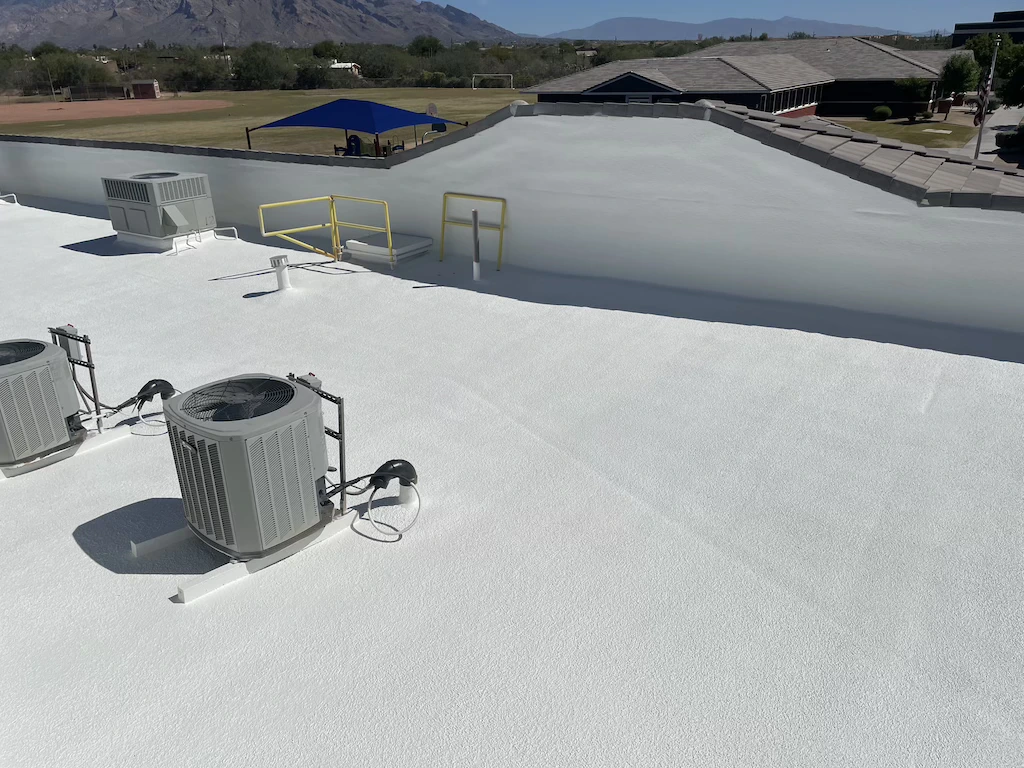
Spray polyurethane foam roofing is more widely used in Tucson and the broader Arizona market than almost anywhere else in the country. SPF is particularly well suited to Southern Arizona for several reasons:
- It creates a seamless, monolithic surface with no seams or laps — eliminating the most common flat roof leak pathways
- It provides outstanding thermal insulation that reduces attic and interior heat gain — meaningful in a market where cooling costs dominate energy bills
- It conforms to any roof shape and can self-level to eliminate existing low spots that cause ponding
- It can be recoated rather than replaced when the protective coating degrades — extending system life significantly and reducing long-term maintenance costs
The key maintenance requirement for SPF roofing is periodic recoating — typically every 10 to 15 years — to maintain UV protection and waterproofing performance. A foam roof that is properly maintained can last the life of the building.
TPO (Thermoplastic Polyolefin)

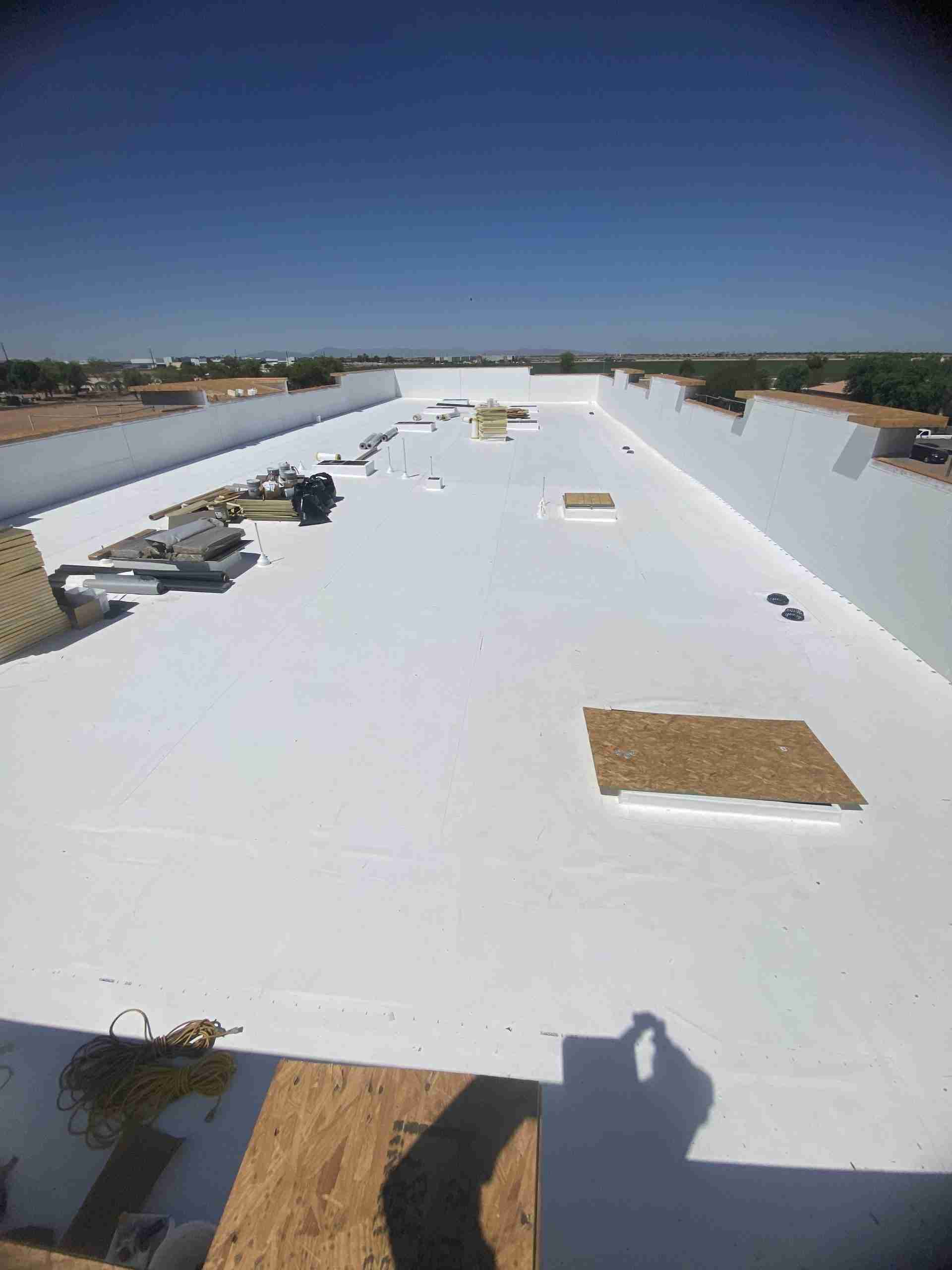
TPO is a single-ply membrane system that has become one of the most widely specified flat roofing materials for commercial and larger residential applications in Tucson. It offers strong UV and heat reflectance, good chemical resistance, and heat-welded seams that create a more reliable joint than adhesive-bonded systems.
In Tucson’s thermal cycling environment, TPO’s flexibility and heat-welded seam integrity make it a reliable performer. White TPO in particular offers strong solar reflectance that reduces rooftop temperatures and cooling loads — a meaningful energy efficiency benefit in Southern Arizona’s climate.
EPDM (Ethylene Propylene Diene Monomer)
EPDM is a rubber membrane system that has been used on flat and low-slope roofs for decades. It performs adequately in Tucson but is less commonly specified for new installations than SPF or TPO because its dark surface absorbs heat — a disadvantage in Tucson’s cooling-dominated climate. Reflective EPDM coatings can address this, but white TPO or coated SPF typically offers better overall energy performance for Southern Arizona applications.
Modified Bitumen
Modified bitumen systems — either torch-applied or self-adhering — are used on flat and low-slope sections throughout Tucson. They offer durability and good puncture resistance but can be susceptible to UV degradation over time in Tucson’s intense solar environment. Granulated surface cap sheets provide better UV resistance than smooth-surface alternatives and are the preferred choice when modified bitumen is specified in this market.
Flat Roof Maintenance in Tucson’s Climate
Flat roofing systems in Tucson require more proactive maintenance than in most other markets due to UV intensity, thermal cycling, and monsoon debris loading. Here’s what responsible flat roof maintenance looks like for a Tucson property:
- Semi-annual inspections: Schedule professional inspections twice per year — once in spring before monsoon season and once in fall after it ends. Pre-monsoon inspections identify drainage vulnerabilities before they’re tested by peak rainfall. Post-monsoon inspections catch any damage the season inflicted.
- Drain and scupper maintenance: Keep all roof drains and scuppers clear of debris year-round — but especially before monsoon season. A blocked drain during a heavy monsoon event can result in rapid ponding that stresses the membrane and potentially the roof structure.
- Coating condition monitoring on SPF roofs: The protective coating on a foam roof is what keeps UV radiation from degrading the foam substrate. When the coating shows signs of crazing, cracking, or color change, recoating should be scheduled before the foam is exposed.
- Seam and flashing inspection on membrane systems: TPO, EPDM, and modified bitumen systems develop vulnerabilities at seams, laps, and flashing edges over time. Thermal cycling in Tucson accelerates this process — particularly at penetrations, parapet walls, and equipment curbs where differential movement is greatest.
- Prompt repair of small issues: In Tucson’s climate, small flat roof problems don’t stay small. A minor seam separation or a small area of coating failure that would be manageable in a cooler, lower-UV environment can expand rapidly under Southern Arizona’s UV and thermal stress.
Repair vs. Restoration vs. Replacement — What Makes Sense in Tucson
Flat roof decisions in Tucson often involve three distinct options — and choosing the right one requires an honest assessment of the system’s current condition.
Repair is appropriate when damage is isolated — a failed seam, a compromised penetration detail, or localized ponding that can be addressed with drainage improvements. If the membrane is in generally good condition and the overall system has meaningful remaining life, targeted repair is the most cost-effective path.
Restoration — typically recoating on SPF systems or applying a new coating layer over an existing membrane — is appropriate when the system is structurally sound but the surface has degraded to the point where repair alone won’t restore adequate performance. Restoration is significantly less disruptive and more cost-effective than full replacement when the underlying system justifies it.

Replacement is the right answer when the membrane or foam substrate has been compromised by moisture, the system has exceeded its practical lifespan, or damage is so widespread that repair and restoration costs approach replacement cost. A professional inspection by an experienced Tucson flat roofing contractor is the most reliable way to determine which path makes sense for a specific roof.
What to Look for in a Flat Roofing Contractor in Tucson
Flat roofing installation, restoration, and repair requires specialized expertise that not every roofing contractor has. Here’s what to verify before hiring for any flat roof project in Tucson:
- Arizona ROC license: Confirm the contractor is licensed through the Arizona Registrar of Contractors before any work begins.
- Genuine SPF and membrane experience in Tucson: Ask specifically how many flat roofing projects the contractor has completed in the Tucson area — including both SPF and membrane systems. Flat roofing in Southern Arizona’s climate requires experience that contractors primarily working in other markets may not have.
- Knowledge of Tucson’s drainage and ponding issues: A qualified Tucson flat roofing contractor should be able to assess your drainage design and identify any ponding vulnerabilities as part of any inspection or project scope.
- Manufacturer certifications: For SPF and coating systems, manufacturer-certified applicators have received training on proper application procedures that directly affect system performance and warranty coverage.
- Written scope and warranty: Any reputable contractor provides a written project scope specifying the system being installed or restored, application rates, warranty terms, and payment schedule.
Schedule a Free Flat Roof Inspection in Tucson, AZ
Whether you own a residential property with a flat addition, a commercial building, or a multi-family structure in Tucson — understanding the condition of your flat roofing system and what it needs is the first step toward protecting your investment.
Sunvek has decades of experience with flat and low-slope roofing systems throughout Tucson and Southern Arizona. We work with SPF, TPO, EPDM, modified bitumen, and coating systems — and we give property owners an honest assessment of what their roof needs, whether that’s a repair, a recoat, or a full replacement. Contact us today to schedule your free inspection.