Flat Roof Replacement or Restoration?
Deciding between flat roof replacement or restoration can be challenging for property owners. While a full replacement provides a brand-new roofing system, restoration can extend the life of your existing roof at a lower cost. Understanding the condition of your roof, budget considerations, and long-term performance expectations will help you make the right choice. In this guide, we’ll break down the differences between flat roof replacement and restoration, the benefits of each option, and how to determine the best solution for your commercial or residential property.
Flat Roof
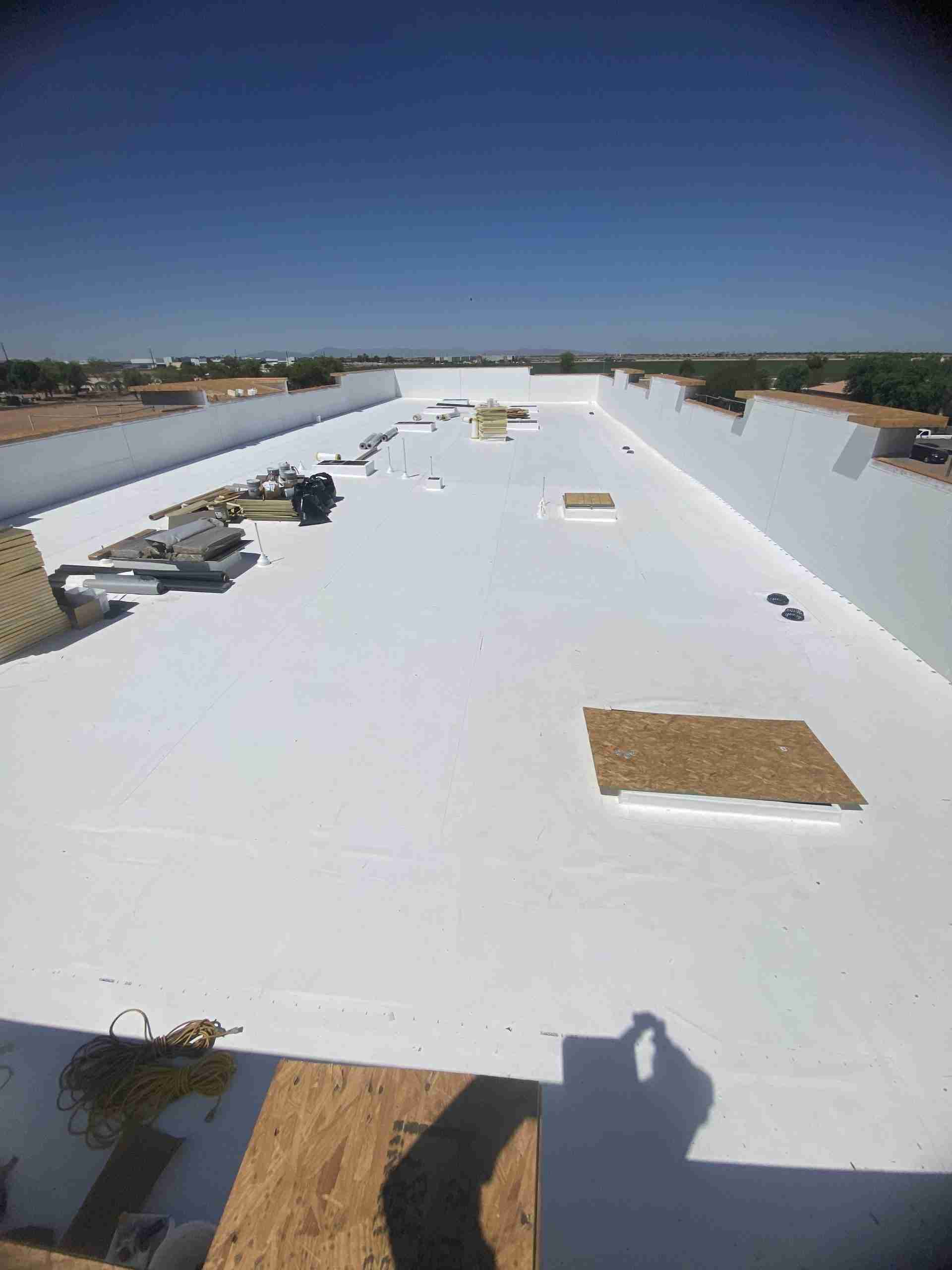
A low-slope roof is generally defined as one that has a slope of less than 2:12, which means that when moving along the roof, for every 12” of movement, the roof slope (commonly referred to as pitch or angle) is less than 2” downward. Think of it as the way water drains. Water moves from a high point to a low point. The low point is where water drains off the roof, either off the eave, possibly thru a scupper, maybe even through a drain.
When we consider flat roofs, those have an even more gradual slope. Typically, on what is known as a flat roof, the drainage slope is less than ½” of fall for every 12” of movement. Since the roof has such a gradual slope, it is not visible from the ground.
Flat Roof Materials
Since a flat roof is not visible from the ground, two primary considerations need to be made: (1) how to keep water out; and (2) which roof system to install. Different materials are available for installation on flat roofs:
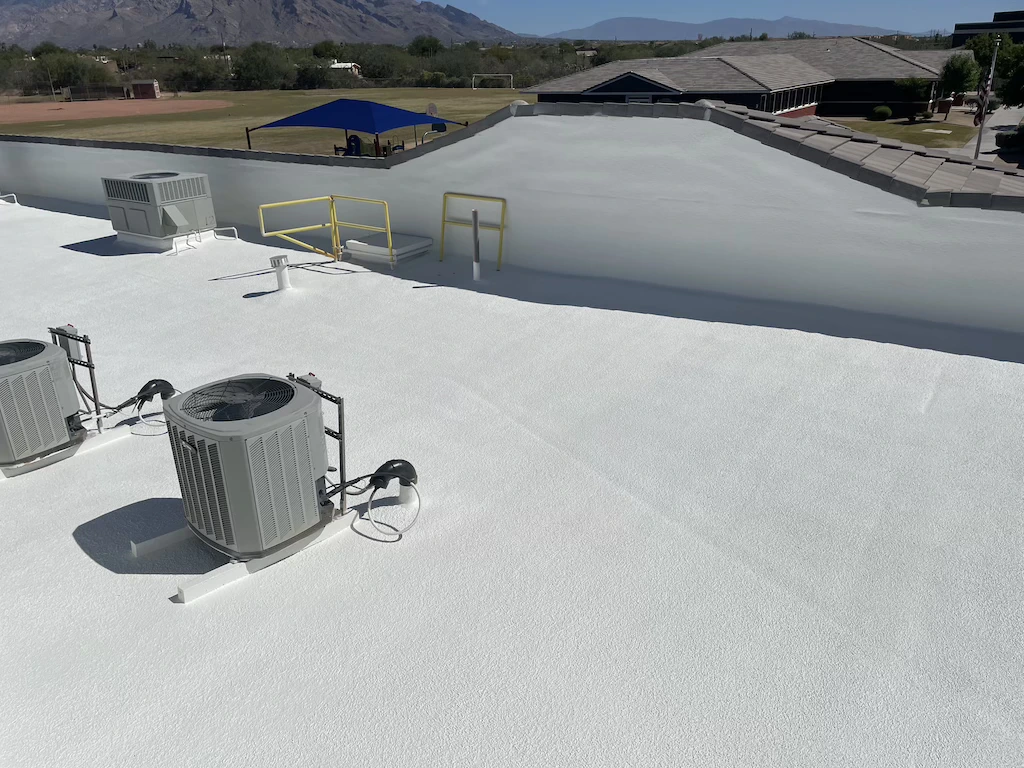
- Spray polyurethane foam is seamless, provides insulation and soundproofing, conforms to a variety of roof angles easily, and is easily maintained
- TPO (thermoplastic polyolefin), PVC (polyvinyl chloride), APP (atactic polypropylene) modified bitumen, and SBS (styrene butadiene styrene) modified bitumen are all roll products that are heat-welded to seal seams. An enclosed head heater is used on TPO and PVC to melt material along lap joints and seams, while an exposed-head torch is typically used to heat modified bitumen products to get them to seal. Self-adhered or fully adhered options are also available
- EPDM (ethylene propylene diene monomer) is a rubber product that is installed with an adhesive and/or plates and screws, with adhesives used to seal at seams and lap joints
Common Performance Characteristics
Spray Polyurethane Foam
- Added soundproofing
- Added insulation
- No seams
- Subject to ultra-violet degradation unless protected by elastomeric acrylic coatings or silicone coatings
- Easily maintained
- If properly installed and maintained, an indefinite lifespan
TPO and PVC
- Installed with either screws and plates or fully adhered
- Seams and lap joints are either heat-welded or adhered together
- Available in a range of thicknesses and colors
- There may be issues with shrinkage
- Typical lifespan is 10-20 years
APP and SBS modified bitumen
- Typically torch-applied, although there are formulations that are self-adhered
- A 2-ply or 3-ply system can last up to 40 years
- Very durable and handles pedestrian traffic well
EPDM
- Applied with either screws and plates or adhesive
- Seams and lap joints are sealed with waterproofing adhesive
- To protect from tearing, underlayment’s are recommended
- Dark color is subject to UV-degradation and brings heat into the building
- Lifespan is likely to be about 10-15 years, although if protected (covered with ballast or other products) the system can last significantly longer
Replacement or Restoration Considerations
Any flat roof system needs periodic maintenance, which includes removal of debris, resealing around penetrations and checking any laps/seams to ensure they remain sealed. At some point, the system will degrade to a point where a decision needs to be made – should I replace the roof system or restore it?
Important factors to consider include:
- The cost to tear off and dispose of the existing roof system
- Interruptions to daily operations of the facility beneath
- Impact on functioning of roof-top equipment while roof work is being performed
- Access to the roof
- Cost of the new roof system or restoration coating
- Warranties
Restoration
Unless the existing roof system is significantly degraded and beyond the point of restoration, coatings are an economical way to extend the life of the roof system and obtain a warranty. What products are available for this purpose? There are three primary products:
- Elastomeric acrylic coatings – either roll or spray-applied, with options for the number of coats and dry-mil thickness. The critical factors are the amount of resin (and quality) in the coating and the amount of titanium in the coating
- Silicone – either roll or spray-applied, with options for the number of coats and dry-mil thickness. Silicone is extremely long-lasting but is subject to tearing. The primary downside is that once silicone is applied, other products do not adhere well to it
- Emulsion – this product is generally applied as a base over asphalt-based products. It consists of bentonite clay, asphalt and water. It serves to fill in and coat the existing system, so another coating (typically elastomeric acrylic) can be applied over it. Excellent over a tar-n-gravel roof system or other system with granules on it
Why Restore a Roof?
The decision whether to replace or restore a roof is determined by a number of factors – cost, ease of application, minimize disruption to routine, warranties.
Application of a coating system results in a number of benefits:
- No (or minimal) system tear off and disposal costs
- Minimal disruption to the daily routine within the building
- Cost-effective – typically 40-70% of the cost of roof replacement, depending on the product and amount applied
- Applicator warranties and product manufacturer warranties are available, extending up to 20 years
- Environmentally beneficial in that landfills aren’t being filled
- Coatings are not classified as a “roof system”, so won’t necessitate removal of an existing roof system prior to application
- A high reflectance value coating (i.e. white) will reflect heat, helping to minimize heat gain in the building
Conclusion
Application of coatings over an aging roof system to restore it and extend its useful life can be a cost-effective means to ensure continued watertightness, even while reducing heat gain. Call (480) 808-7926 to schedule a roof inspection today!